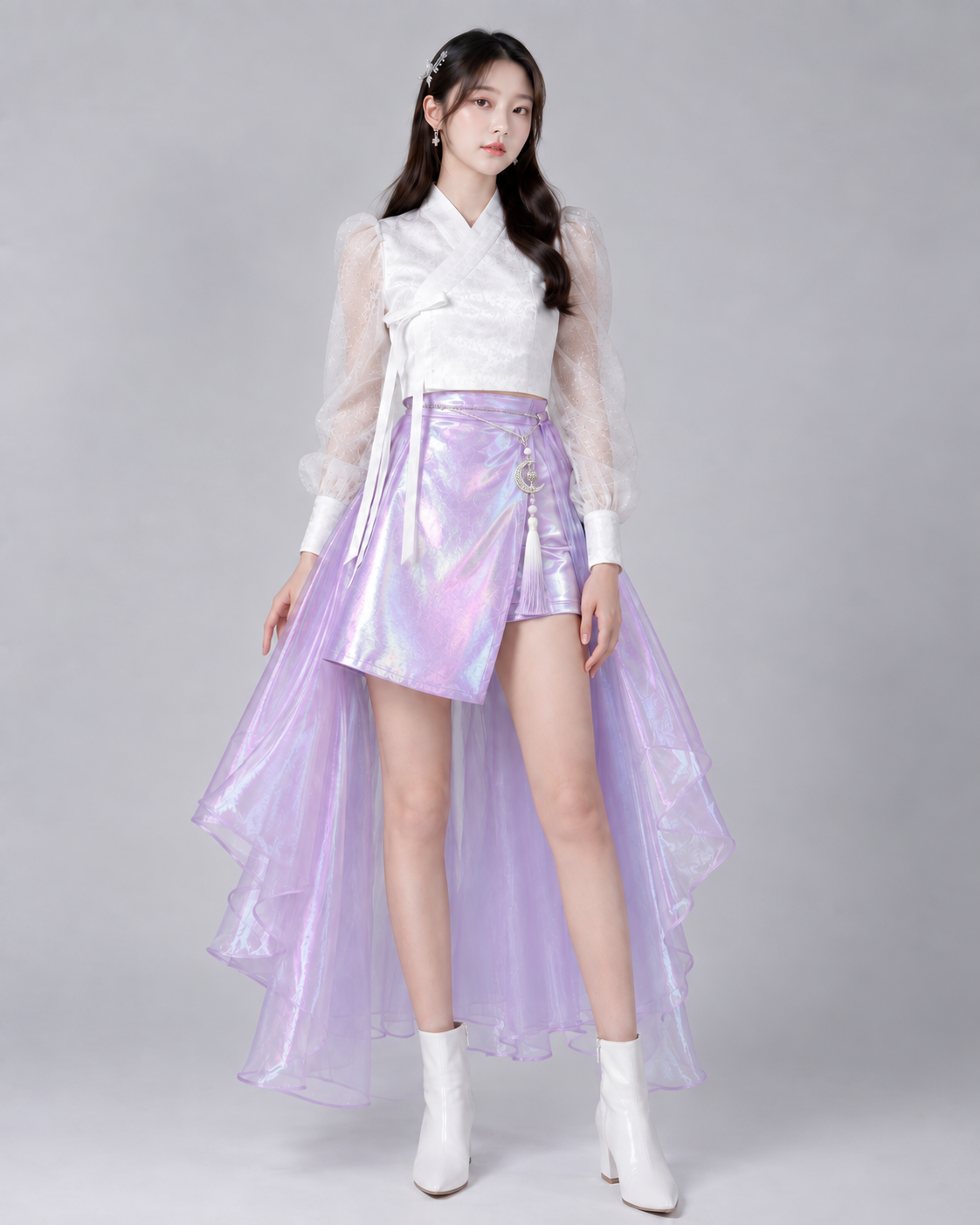
What Is a Hanbok? Everything You Need to Know About Korea's Most Beautiful Traditional Dress

What Is a Hanbok? Everything You Need to Know About Korea's Most Beautiful Traditional Dress

Search hanbok online and you will find thousands of photographs: flowing skirts in jewel-bright colours, cropped jackets with hand-tied ribbons, elaborate hair ornaments catching the light at Gyeongbokgung Palace. Beautiful. Photogenic. Instantly recognisable.

But here is what most of those photographs do not tell you: hanbok is not a photoshoot costume. It is a complete traditional dress system that has carried the weight of Korean ceremony, celebration, and daily life for over a thousand years. Every element carries meaning. Every detail has a story.

A hanbok is not just clothing. It is a festival, a wedding, a blessing, and four seasons of life, all folded into a single garment.

Korean hanbok champagne jeogori navy brocade chima night lantern

The hanbok at its most atmospheric: a champagne-gold jeogori paired with a deep navy brocade chima, worn at night among glowing lanterns and traditional Korean architecture.

👉 White and Pink Hanbok — Korean High-End Court Dress | Purple Hanbok — Korean Princess Palace Dress


🏛️ Part One: What Does Hanbok Actually Mean?

The word hanbok is deceptively simple: han means Korean, and bok means clothing. But that translation barely scratches the surface. Hanbok is not a single garment but a complete dress system: a coordinated set of upper and lower garments, accessories, footwear, and hair ornaments, each element chosen with care and worn with intention.

📜 A Thousand Years of History

Hanbok origins trace back to the Three Kingdoms period (57 BCE to 668 CE). It was during the Joseon dynasty (1392 to 1897) that hanbok reached its most refined form. Confucian values shaped every aspect of dress: the length of a sleeve, the colour of a collar, the weight of a fabric all communicated the wearer's social rank and the occasion being observed. Today, hanbok exists in a third act: a living tradition reimagined by Korean designers for contemporary life.

✨ The Core Aesthetic: Harmony, Not Drama

Hanbok is not designed to sculpt or constrain the body. Its lines are generous, its silhouette flowing. The high-waisted chima creates a long, unbroken vertical line from chest to floor. The result is a garment that looks most beautiful in motion.


🧵 Part Two: The Anatomy of a Hanbok

👗 Women's Hanbok: The Jeogori and Chima

Korean hanbok blue sheer organza jeogori ivory chima goreum ribbon

Deep navy sheer organza jeogori over a white inner layer, with a generous goreum ribbon bow and a full ivory chima. The colourful floral hair accessories and traditional wooden interior create a look that is simultaneously historical and completely contemporary.

  • Short, cropped jeogori sitting just below the bust, creating the high-waisted silhouette that is hanbok's most distinctive visual feature
  • White inner collar (dongjeong), always white, always precisely folded, a symbol of purity and care
  • Goreum ribbon tie, the long, hand-tied ribbon that closes the jeogori at the front
  • Ultra-high chima waistline tied at the chest, creating a dramatically elongated silhouette and the appearance of longer legs
  • Full, gathered chima volume with multi-layer construction giving the skirt its characteristic body and drape

👉 White Hanbok Palace Dress — Traditional Korean Women's Outfit | Blue Purple Hanbok — Korean Princess Dress, Traditional Joseon Style

🤴 Formal Court Dress

Korean hanbok full white court dress wide sleeves palace architecture

A full white court hanbok with dramatically wide sleeves and a red waist sash, worn against the backdrop of a traditional Korean palace. This is the formal end of the hanbok spectrum: a garment of ceremony, presence, and cultural weight.

  • Men's Jeogori, longer and more relaxed, falling to the hip or upper thigh, conveying quiet authority and dignity
  • Baji — Wide Trousers, wide, generously cut trousers that taper at the ankle
  • Dopo or Magoja — outer robe, for formal occasions, adding ceremony and visual weight

✨ Accessories: The Soul of Hanbok

  • Norigae — decorative tassel pendant; jade signifies purity and good fortune, coral represents vitality
  • Binyeo — Hair Pin, ornamental pin used to secure the traditional Korean updo
  • Embroidered patterns: peonies (wealth), lotus (purity), cranes (longevity), clouds (good fortune)

👉 Couple Hanbok Wedding Outfit — Korean Palace Style with Lace Detail | Blue Couple Hanbok Set — Traditional Korean Dress for Couples


🌈 Part Three: Fabric, Colour and Season

Korean hanbok lavender purple chima white jeogori cherry blossom spring

The lavender and white hanbok is a masterclass in colour harmony: the pale purple chima and white jeogori sit in perfect tonal balance, echoing the cherry blossom backdrop. This is the Morandi palette applied to traditional Korean dress.

Season Fabric Character
☀️ Summer Ramie (mosi), thin silk gauze Breathable, crisp, moves like water
🌸 Spring and Autumn Silk (myeongju), light brocade Lustrous, fluid drape with soft sheen
❄️ Winter Padded silk (nubi), heavy brocade, velvet Warm, structured, opulent
  • Vivid primary colours — celebration and new beginnings; worn at weddings, Seollal, and Chuseok
  • Muted, undyed tones — everyday dignity and scholarly restraint
  • Pure white — purity and the sacred; both mourning and the highest ceremonial formality

👉 Blue Princess Hanbok Dress — Modern Korean Palace Style | Purple Hanbok — Korean Princess Palace Dress


🌟 Part Four: When Is a Hanbok Worn?

Korean couple hanbok wedding black brocade ivory lace court dress palace winter

A couple's hanbok at its most formal: the groom in black brocade with gold medallion embroidery, the bride in ivory lace court dress. The traditional Korean palace backdrop and winter light create a scene of extraordinary elegance.

👉 Couple Hanbok Wedding Outfit — Korean Palace Style with Lace Detail | Blue Couple Hanbok Set — Traditional Korean Dress for Couples

🎊 Traditional Festivals

Seollal (Lunar New Year) and Chuseok (harvest festival) are the two great occasions when hanbok wearing is most widespread. Families dress in their finest hanbok to perform ancestral rites, exchange deep bows of respect, and share the ritual foods of the season。

💍 Life's Milestones

  • Doljanchi — First Birthday: The child is dressed in the most colourful hanbok of their life
  • Gyeollye — Wedding: The bride's wonsam or hwarot is one of the most spectacular garments in East Asian dress tradition
  • Hwangap — 60th Birthday: The honoured elder wears red hanbok, the colour of vitality and long life
  • Gwanrye — Coming of Age: Young people dress in traditional hanbok and receive symbolic gifts

📸 Modern Occasions

  • Travel photography at Gyeongbokgung, Bukchon Hanok Village, Jeonju Hanok Village
  • Cultural experience tourism at major cultural sites
  • Themed photoshoots and content creation
  • Everyday modern wear for work, dinner, or a weekend afternoon

👉 Blue Purple Hanbok — Korean Princess Dress, Traditional Joseon Style | Blue Princess Hanbok Dress — Modern Korean Palace Style


🌿 Part Five: Modern Hanbok — Tradition Unchanged, Comfort Doubled

Korean modern hanbok ivory white jeogori pink chima minimal everyday style

Modern hanbok at its most wearable: an ivory white sheer jeogori with a soft pink chima, styled with a long braided plait and minimal accessories. This is the everyday hanbok you can wear to a coffee shop, a gallery, or a weekend afternoon.

The most exciting development in hanbok today is modern hanbok (saenghwal hanbok), a design movement that preserves the essential silhouette and cultural DNA of traditional hanbok while adapting it for contemporary life.

  • Inclusive fit — cut to flatter a wider range of body types with adjustable waistlines
  • Practical fabric — soft, skin-friendly, easy to care for, resistant to wrinkling
  • Versatile styling — dress up with traditional accessories or down with contemporary shoes

👉 White and Pink Hanbok — Korean High-End Court Dress | Blue Princess Hanbok Dress — Modern Korean Palace Style


❤️ Closing: Why Hanbok Is Worth Wearing

Hanbok is not just clothing. It is Eastern aesthetics, cultural story, and ceremonial presence — all folded into a single garment that has survived a thousand years of history without losing its essential beauty.

When you put on a hanbok, you are not wearing a costume. You are wearing a garment that has been worn at weddings and funerals, at royal banquets and village festivals, at the first birthday of a child and the sixtieth birthday of a grandparent.

When you wear a hanbok, you own not just a unique garment — you own a wearable cultural memory. Choose one with quality, with meaning, and with the intention to wear it well.

🛍️ Shop Our Hanbok Collection

👉 Browse Our Full Hanbok Collection →

Seitenleiste

Blog-Kategorien

Dieser Abschnitt enthält derzeit keinen Inhalt. Fügen Sie über die Seitenleiste Inhalte hinzu.

Neueste Beiträge

Dieser Abschnitt enthält derzeit keinen Inhalt. Fügen Sie über die Seitenleiste Inhalte hinzu.

Blog-Tags