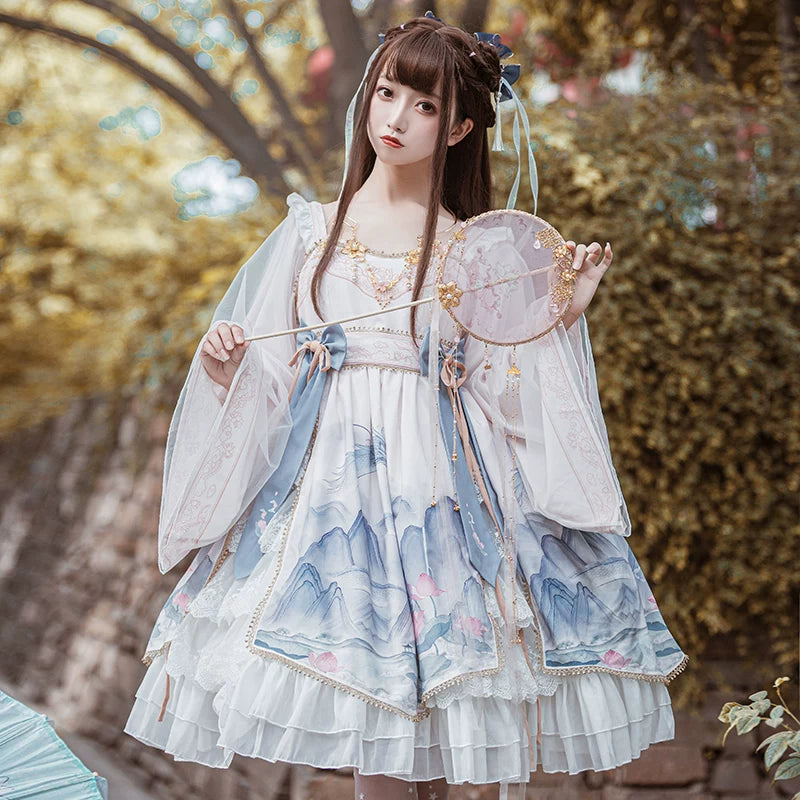
Few garments in the world carry the same quiet power as the hanbok — Korea's traditional dress, worn for over a thousand years and still as breathtaking today as it was in the royal courts of the Joseon dynasty. With its sweeping silhouettes, jewel-bright colours, and delicate silk ribbons, hanbok is not just clothing. It is a living expression of Korean identity, philosophy, and beauty.
Whether you're drawn to hanbok for a cultural celebration, a photoshoot, a wedding, or simply a deep appreciation of East Asian fashion, this guide will walk you through everything you need to know — from the signature features that define hanbok to the fabrics that once separated royalty from commoner.
What Is Hanbok?
Hanbok (한복) literally means "Korean clothing" — han (한) referring to Korea, and bok (복) meaning clothing. It is the traditional dress of the Korean people, with roots stretching back to the Three Kingdoms period (57 BC – 668 AD). Over the centuries, hanbok evolved through the Goryeo and Joseon dynasties, absorbing influences from Chinese court dress while developing a distinctly Korean aesthetic: clean lines, bold colour contrasts, and a silhouette that seems to float rather than fall.
Today, hanbok is worn at major life events — weddings, the first birthday celebration (doljanchi), Lunar New Year (Seollal), and the autumn harvest festival (Chuseok) — as well as at cultural performances, photoshoots, and increasingly, as a statement of modern Korean pride.
✨ The Signature Features of Hanbok Korean Dress
What makes hanbok instantly recognisable — and endlessly captivating — is a set of core design principles that have remained remarkably consistent across centuries:
1. Vibrant, Intentional Colour
Colour in hanbok is never arbitrary. Traditional Korean colour theory, rooted in the obangsaek (five cardinal colours — blue, red, yellow, white, and black), guided how hanbok was coloured and combined. Bright, saturated hues were favoured for celebrations; softer, muted tones for everyday wear. The contrast between the jeogori (jacket) and chima (skirt) is one of the most visually striking elements of women's hanbok — bold yellow against deep forest green, dusty rose against charcoal, ivory against slate blue.
2. Graceful, Flowing Silhouette
Hanbok is designed to move. The women's chima (skirt) is cut in a full, umbrella-like shape that billows and flows with every step, creating a sense of effortless elegance. The garment does not cling to the body — it surrounds it, creating a silhouette that is simultaneously modest and deeply beautiful.
3. The Ribbon Tie — Goreum
Traditional hanbok has no buttons, no zips, and no pockets. The garment is held together entirely by the goreum — long silk ribbons that tie in a bow at the chest. This ribbon tie is one of the most iconic elements of hanbok, and tying it correctly is considered an art in itself. The bow sits just below the collar, often in a contrasting colour to the jacket, and its gentle asymmetry gives hanbok much of its characteristic charm.
4. No Pockets
Traditional hanbok contains no pockets whatsoever. Small personal items were carried in a jumeoni — a decorative drawstring pouch, often embroidered and hung from the ribbon tie or worn at the wrist. These pouches are themselves considered beautiful accessories and are still worn today as a traditional detail.
👗 Women's Hanbok: Jeogori & Chima

↑ A classic women's hanbok in golden yellow and deep forest green — the purple goreum ribbon tie at the chest, the embroidered cuffs, and the full umbrella-shaped chima skirt are all defining features of traditional Korean dress. Note the decorative jumeoni pouch hanging from the ribbon — a traditional substitute for pockets.
The women's hanbok consists of two core pieces:
- Jeogori (저고리) — a short, fitted jacket with long sleeves. The collar (git) is typically white, creating a clean contrast against the coloured jacket. The cuffs (hansam) are often a different colour or fabric, and may be embroidered with floral motifs. The jacket is cropped high — sitting just below the bust — which creates the characteristic high-waisted silhouette of women's hanbok.
- Chima (치마) — a full-length, high-waisted skirt that wraps around the body and ties at the chest. The skirt is cut generously — sometimes using up to 12 metres of fabric — to create its signature full, flowing shape. It may be a solid colour, a subtle woven pattern, or richly embroidered with flowers, birds, or geometric motifs.
Together, the jeogori and chima create a silhouette that is uniquely Korean: high-waisted, full-skirted, and gracefully elongated. The long goreum ribbons trail down the front of the skirt, adding movement and a sense of gentle formality.
👉 Shop Women's Hanbok: Purple Korean Hanbok — Traditional Embroidered Hanbok for Weddings & Festivals | Pastel Embroidered Korean Hanbok — Elegant Traditional Korean Dress
🧖 The Art of Embroidery in Women's Hanbok

↑ An exquisite example of embroidered hanbok — the ivory jeogori is covered in delicate silver-white floral embroidery, paired with a blush pink chima in a subtly textured fabric. The grey goreum bow sits neatly at the chest. This style represents the refined aesthetic of upper-class Joseon dynasty dress.
Embroidery (자수, jasu) has been an integral part of Korean textile culture for centuries. On hanbok, embroidery appears most commonly on the cuffs, collar, and hem of the jeogori, and occasionally across the full surface of the skirt. Traditional motifs include:
- Peonies (모란) — symbolising wealth, honour, and feminine beauty
- Chrysanthemums (국화) — representing longevity and resilience
- Plum blossoms (매화) — a symbol of perseverance and the arrival of spring
- Cranes (학) — associated with longevity, nobility, and good fortune
- Butterflies (나비) — representing joy, transformation, and marital happiness
The quality and density of embroidery was historically a marker of social status — the more elaborate the embroidery, the higher the wearer's rank. Today, embroidered hanbok remains the most formal and prestigious style, worn for weddings, royal-themed photoshoots, and major cultural celebrations.
👉 Shop Embroidered Hanbok: Blue Hanbok Korean Princess Palace Dress | Pink Korean Traditional Court Dress
🤵 Men's Hanbok: Jeogori & Baji
Men's hanbok shares the same fundamental structure as women's hanbok — a jeogori jacket and a lower garment — but with a distinctly different aesthetic: simpler, more relaxed, and designed for ease of movement.
- Jeogori (저고리) — the men's jacket is longer and looser than the women's version, falling to the hip rather than the bust. It is typically in a single, understated colour — deep navy, charcoal, warm brown, or ivory — with minimal embellishment. The goreum ribbon tie is present, but often smaller and less decorative than in women's hanbok.
- Baji (바지) — wide-leg trousers with a generous cut that allows full freedom of movement. The baji are tied at the waist with a drawstring and often gathered at the ankle with a ribbon or band. The wide, flowing silhouette of the baji is one of the most practical and distinctive elements of men's hanbok — designed for a culture that sat, knelt, and moved on the floor.
Over the jeogori, men often wear a magoja (마고자) — a short, collarless overcoat — or a dopo (도포) — a long, formal outer robe worn by scholars and officials. These outer layers add formality and visual weight to the men's hanbok silhouette.
🧵 Fabrics & Social Class: Silk, Linen & Cotton

↑ A contemporary luxury hanbok in sage green and slate blue — the jeogori features 3D floral lace appliqué across the sleeves and body, while the chima is cut in a dramatic ombre organza. The tassel goreum adds an elegant finishing detail. This style bridges traditional hanbok structure with modern couture techniques.
In traditional Korean society, the fabric of your hanbok told the world exactly who you were. The hierarchy of hanbok fabrics was strict and socially enforced:
Upper Class — Silk (Myeongju, 명주)
The aristocracy (yangban) and royal family wore hanbok made from fine silk — smooth, lustrous, and richly coloured. Silk hanbok draped beautifully, held embroidery well, and caught the light in a way that no other fabric could replicate. The finest silk hanbok were works of art in their own right, sometimes taking months to produce.
Commoners — Linen in Summer (Sambe, 삼베)
Common people wore hanbok made from sambe — a coarse linen woven from hemp fibres. Linen hanbok was breathable and practical for the hot, humid Korean summer, but lacked the lustre and drape of silk. It was typically undyed or in natural, muted tones.
Commoners — Cotton in Winter (Mosi & Myeon)
In winter, commoners wore hanbok padded with cotton batting for warmth. This solbit (솜빛) style — a quilted, padded hanbok — was practical and warm, though far less elegant than the silk versions worn by the upper classes. Cotton hanbok was also more accessible and easier to wash and maintain.
Today, modern hanbok is made from a wide range of fabrics — from traditional silk and linen to contemporary organza, chiffon, lace, and even velvet — allowing for a much broader range of styles, price points, and occasions.
👉 Shop by Style: Blue & Pink Traditional Korean Hanbok | Orange Yanji Korean Daily Hanbok Dress | Pink Hanbok — Traditional Korean Court Dress for Events
🌸 When to Wear Hanbok Korean Dress

↑ A richly coloured hanbok in deep burgundy and blush pink — the teal goreum ribbon creates a striking colour contrast, while the chima features a delicate botanical print in silver-grey. This style is ideal for formal celebrations, weddings, and cultural events where a traditional yet refined look is desired.
Hanbok is worn across a wide range of occasions in Korean culture, each with its own conventions and colour traditions:
💍 Weddings (Gyeollye)
The wedding hanbok is among the most elaborate and beautiful. Brides traditionally wear a wonsam (원삼) — a long, formal outer robe in green or red — or a hwarot (활옷) — a richly embroidered ceremonial robe in red and blue. Grooms wear a formal gwanbok (관복) — the official court dress of the Joseon dynasty. Today, many Korean couples choose modern hanbok in softer, more contemporary colours for their wedding ceremonies.
🎂 First Birthday (Doljanchi)
The first birthday is one of the most important celebrations in Korean culture. Babies are dressed in brightly coloured hanbok — typically in primary colours — and the celebration includes a ritual (doljabi) in which the child reaches for objects that are said to predict their future.
🌙 Lunar New Year (Seollal) & Chuseok
Korea's two major traditional holidays are the most common occasions for everyday Koreans to wear hanbok. Families dress in their finest hanbok to perform ancestral rites (charye), visit relatives, and celebrate together. Bright, festive colours are favoured — reds, blues, greens, and golds.
📸 Photoshoots & Cultural Tourism
Hanbok rental and photoshoots have become enormously popular — both in Korea and internationally. Wearing hanbok at historic palaces like Gyeongbokgung in Seoul has become a beloved cultural experience for visitors from around the world. The combination of traditional architecture and flowing hanbok creates some of the most beautiful travel photography imaginable.
🌟 Modern Hanbok: Tradition Reimagined
Contemporary Korean designers have embraced hanbok as a canvas for innovation, creating styles that honour the traditional silhouette while incorporating modern fabrics, techniques, and aesthetics. Modern hanbok features:
- New fabrics — organza, chiffon, lace, velvet, and ombre-dyed textiles that create dramatic visual effects impossible with traditional materials
- 3D embellishments — appliquéd flowers, beading, and dimensional embroidery that add texture and depth
- Simplified silhouettes — shorter skirts, slimmer cuts, and more relaxed proportions for everyday wearability
- Fusion styling — hanbok jeogori worn with modern trousers, or chima skirts paired with contemporary tops
The result is a living tradition — one that continues to evolve while remaining deeply rooted in the aesthetic principles that have defined Korean dress for over a millennium.
🛍️ Shop Our Hanbok Korean Collection
Whether you're looking for a traditional hanbok for a wedding or cultural celebration, or a modern fusion style for a photoshoot or special event, our collection has something for every occasion:
- 💜 Purple Korean Hanbok — Traditional Embroidered Hanbok — for weddings, cultural festivals & photoshoots
- 🦴 Pastel Embroidered Korean Hanbok — elegant and refined for formal occasions
- 💙 Blue & Pink Traditional Korean Hanbok — a classic colour combination with timeless appeal
- 🧡 Orange Yanji Korean Daily Hanbok Dress — vibrant and wearable for everyday cultural occasions
- 👑 Blue Hanbok Korean Princess Palace Dress — inspired by Joseon dynasty court dress
- 🌸 Pink Korean Traditional Court Dress — soft and feminine for celebrations and photoshoots
- 💚 Blue Hanbok Korean Dress — Women's Court Dress — elegant and historically inspired
- 🍑 Pink Hanbok — Traditional Korean Court Dress for Events — perfect for cultural events and formal occasions
Hanbok is more than a costume — it is a connection to one of the world's most beautiful and enduring fashion traditions. Wear it with pride, wear it with joy, and let it tell your story. ✨