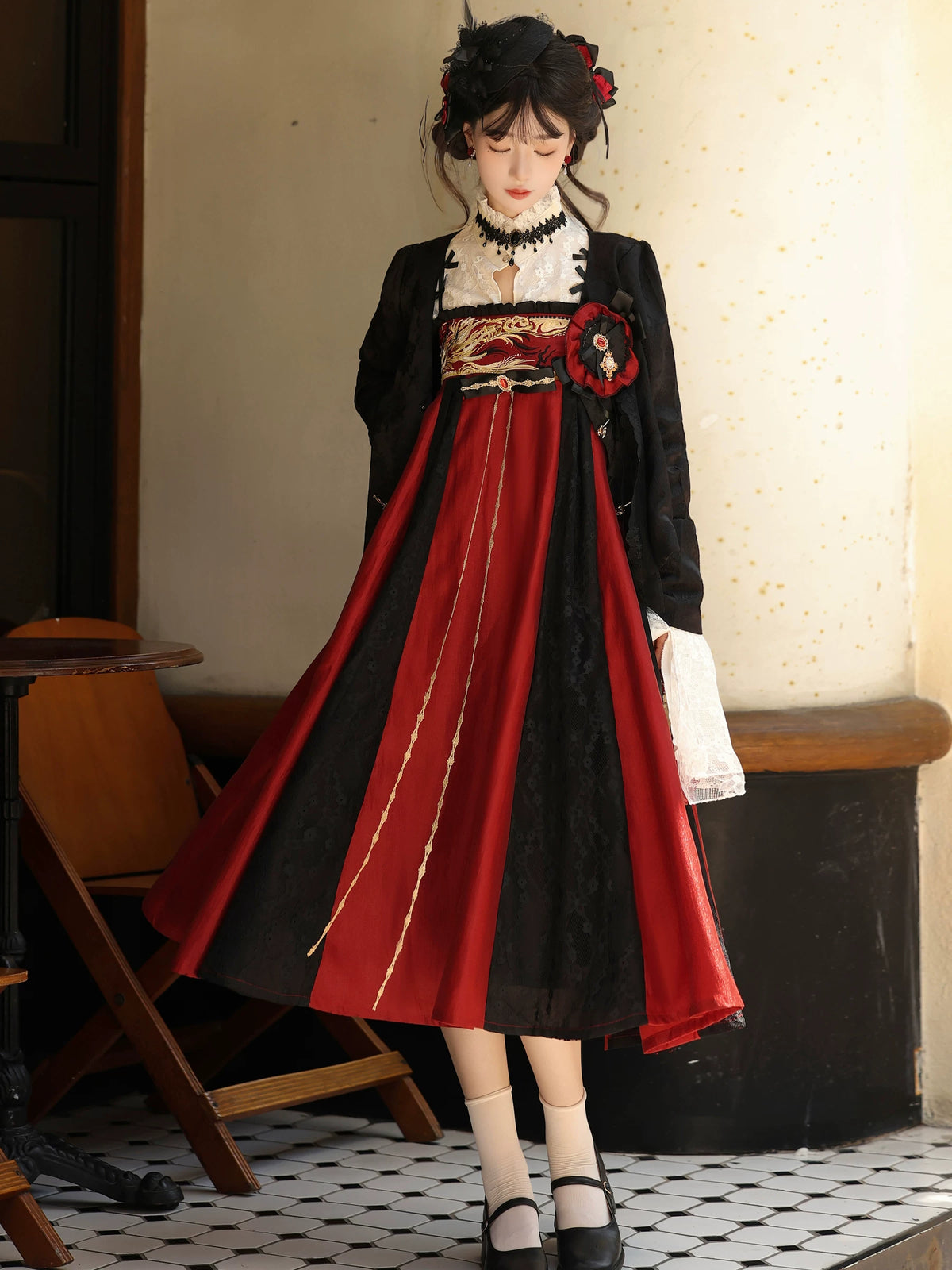
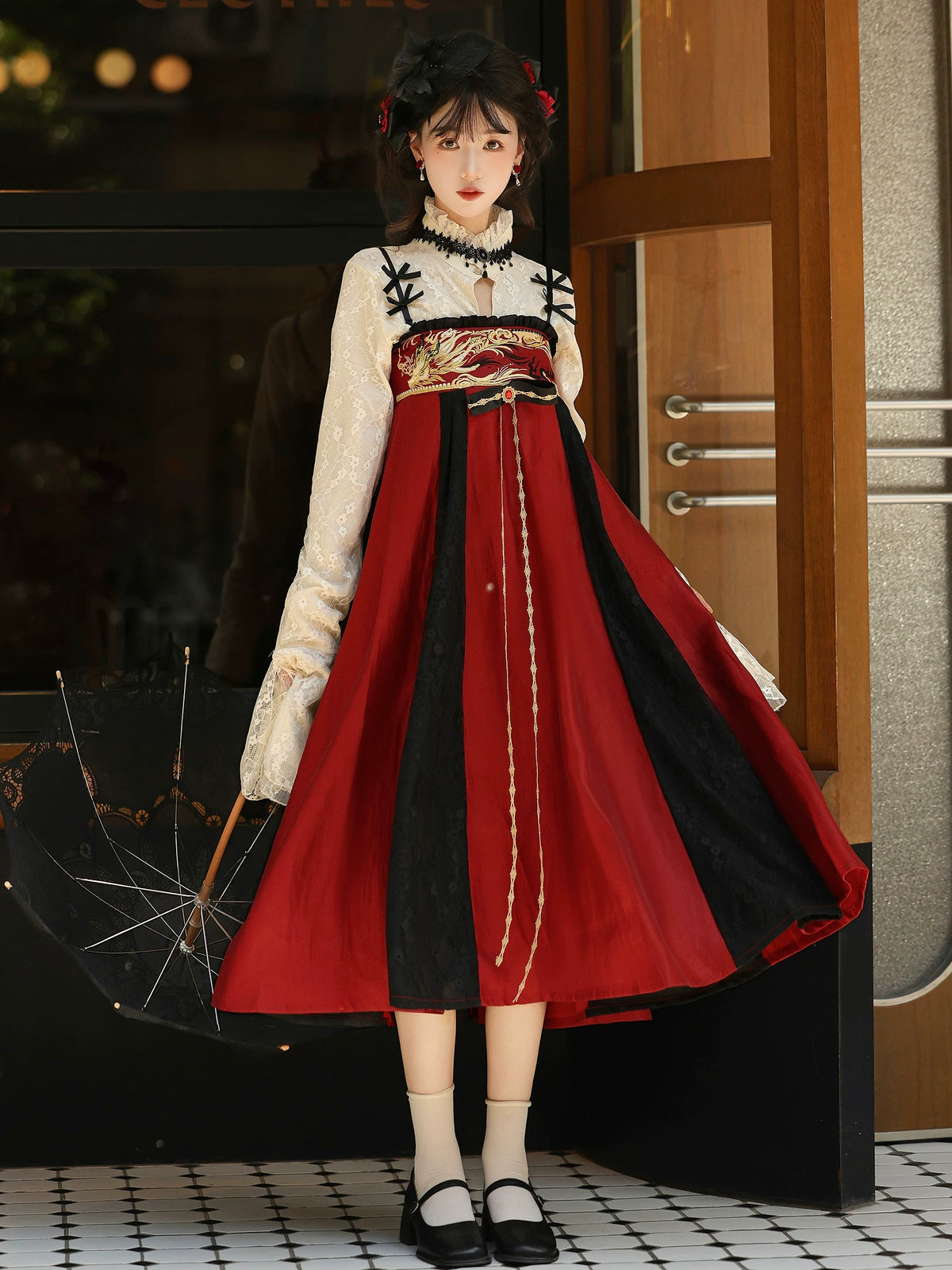
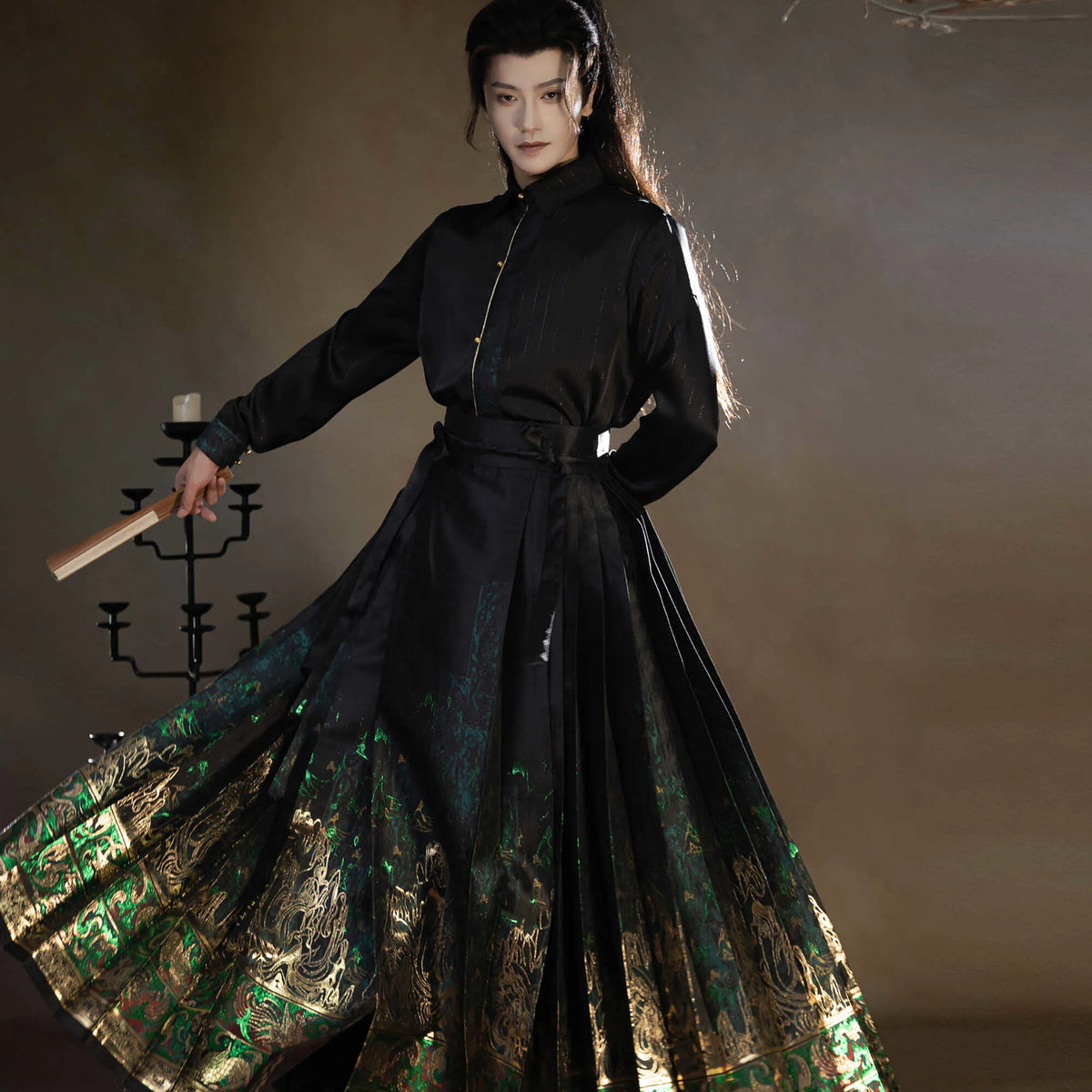
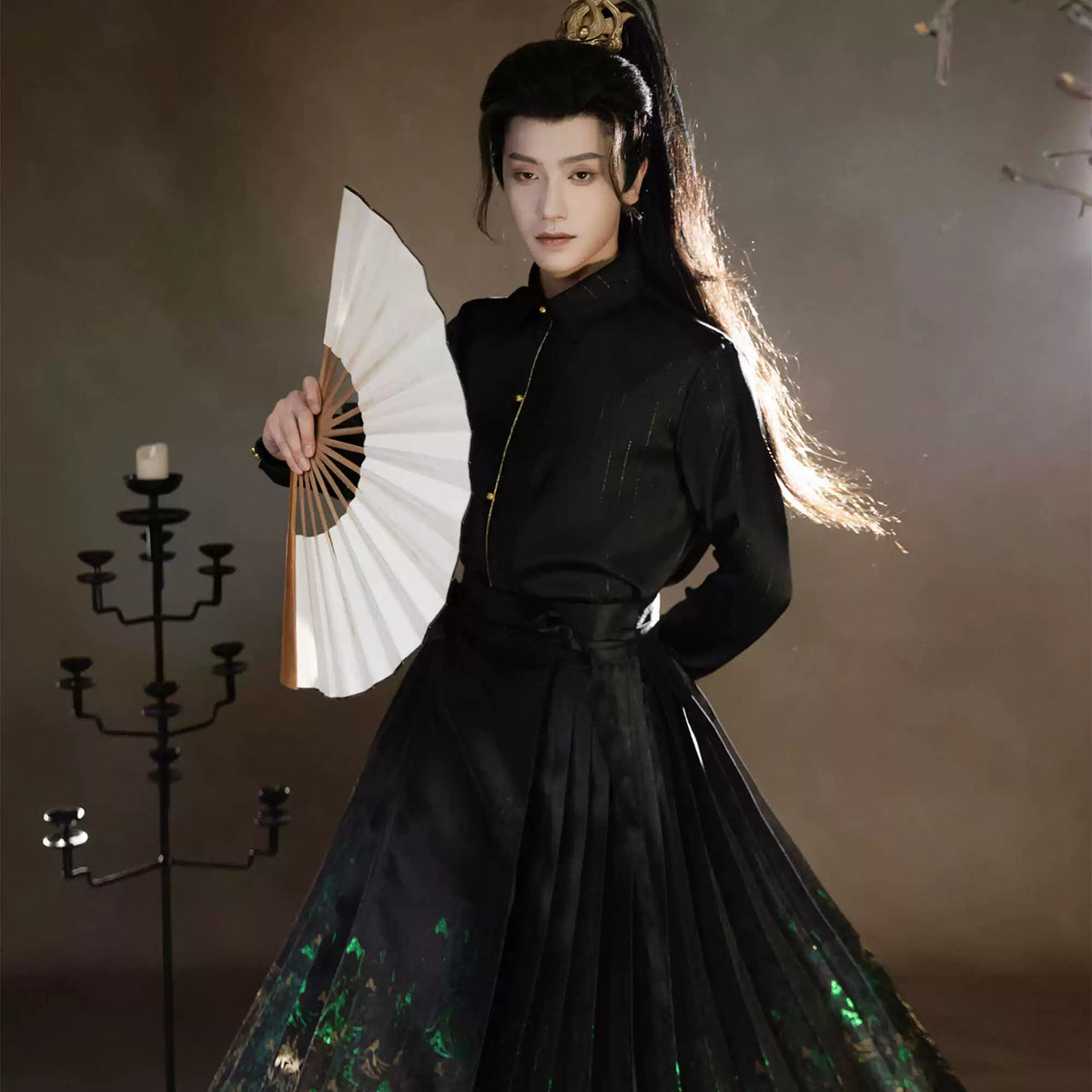
Stop Saying
Hanfu Is Only
for Women.
Men Look Incredible in It.
You have seen it. You have saved the link. You have talked yourself out of it. This guide is for that moment — and it ends with you placing an order.
How Many Men Have Secretly Saved a Hanfu Link and Never Ordered?
You are scrolling. You see a man in a flowing dark robe, wide sleeves, a jade pendant at the waist, posture like he owns the room. Something registers: that looks incredible. Then, almost immediately: I could never pull that off. People would say things. And you close the tab.
This guide is for that moment — the moment between seeing something you genuinely want and talking yourself out of it because of what you imagine other people might think.
Where Did the “Hanfu on Men = Feminine” Bias Come From?
Cream gold dragon-embroidered da chang — this is what male hanfu actually looks like. Not a costume. Not feminine. Just exceptional.
This bias has a traceable origin. It did not come from history. It came from three specific modern sources — and once you see them, the bias loses most of its power.
Source 01
Film & TV Casting
In historical dramas, elaborate male hanfu goes to villains and eunuchs. The hero wears armor. This is a producer’s decision — not history. In actual Chinese history, the most powerful men wore the most elaborate robes.
Source 02
Cheap Costume Rentals
Synthetic fabric, garish embroidery, ill-fitting cuts. That is not hanfu. Judging male hanfu by costume-rental standards is like judging a bespoke suit by a Halloween costume.
Source 03
Men’s Fashion Collapse
Black, grey, navy, sportswear. That’s it. Men in Scotland wear kilts. Men in Japan wear yukata. Men in West Africa wear embroidered robes. None of it is called feminine. The problem is the narrowness of the frame.
The Three Styles — Pick Your Entry Point
The Warrior
“Ten Steps, One Kill. A Thousand Miles, No Trace.” — For the man who wants to walk into a room and have people notice
Left: Blue-black wide-sleeve warrior style — Right: Black red gold dragon embroidery with sword. Both are what “warrior hanfu” actually means.
Key Styles
- Ye san — fitted military robe
- Feiyu fu — imperial guard robe
- Zhao jia — warrior over-vest
- Jian xiu — arrow-cuff jacket
What Makes It Work
- Fitted waist — defines silhouette
- Narrow cuffs — clean, precise
- Strong vertical lines — adds authority
- Dark colorways — black, navy, charcoal
In a sportswear outfit, you are “that guy.” In a feiyu fu, you are “who is that?”
👉 Embroidery Gradual Change Flower Couple Hanfu — Men & Women Spring Festival | Ming Dynasty Hanfu — Red Imitation Flower Couple’s Style
The Scholar
“The Man on the Road Is Like Jade. A Gentleman Without Equal.” — For the man who wants to look like he has read every book in the room
Left: White flowing dao pao at ancient architecture — Right: White gold ceremonial scholar robe. The scholar style has a range — from understated to unforgettable.
Key Styles
- Dao pao — Taoist robe, wide and flowing
- Zhi zhuo — scholar’s straight robe
- Yuan ling pao — round-collar court robe
- Da chang — wide outer cloak
What Makes It Work
- Loose, flowing silhouette — unhurried
- Ink grey, sage, deep cream tones
- Minimal embellishment — fabric speaks
- Jade or wooden accessories
Every woman’s idea of a “gentle, cultured man” is wearing a dao pao in her imagination. Now you know what to wear.
👉 Original Song Dynasty Hanfu — Trailing Large-Sleeved Shirt & Wedding Clothes | The Prosperous Tang Dynasty Traditional Hanfu
The Everyday
Nobody will know it’s hanfu. They’ll just think you have exceptional taste. — For the man who wants to try without announcing it
Key Styles
- Dui jin short jacket — center-opening
- Song-dynasty trousers — relaxed, structured
- Hanfu-influenced contemporary pieces
How to Style It
- Dark jeans or chinos
- White sneakers or leather loafers
- No accessories needed — jacket does the work
You are already wearing clothes. Why not wear something that actually has something to say?
👉 Elegant Princess Dress Flower Daily Sweet Hanfu | Ming Dynasty Purple Horse Dress Hanfu
Where Does the Masculinity of Male Hanfu Actually Come From?
This is the question worth sitting with. Because the answer is not what most people expect.
Not muscle. Bearing.
Male hanfu does not display the body — it reveals the person inside it. The way a man moves in a dao pao, the way he holds his posture in a ye san — this is what the garment expresses. Not the body. The character.
Not performing confidence. Having it.
Wearing something genuinely different requires a specific kind of confidence — not the confidence of someone who needs approval, but of someone who has already decided what they think and does not need the room to agree.
Not retro. Reclamation.
Men in Scotland wear kilts. Men in Japan wear yukata. Men in West Africa wear embroidered robes. Nobody calls it feminine. The question is not whether men can wear traditional dress. The question is why Chinese men have been convinced their own traditional dress is off-limits.
Stop Waiting. If You Like It, Wear It.
You have one life. A specific, finite number of mornings where you get to decide what to put on. Spending those mornings in the same rotation of grey t-shirts and dark jeans because you are worried about what someone might think is, when you say it out loud, a strange way to spend a life.
Here is the double standard worth naming: when a woman wears hanfu, it is called “celebrating traditional culture.” When a man wears hanfu, it gets called “weird.” This is not a reflection of the garment. It is a reflection of how narrow our expectations for men have become.
🧵 It is not a costume — Two thousand years of history and a considered aesthetic that has nothing to do with performance.
💪 It is not feminine — Designed by men, worn by men, carrying the aesthetic values of the most powerful men in Chinese history.
🌟 It might be for you — The only way to find out is to try it. Start with the everyday style. Or go straight to the warrior.
Leave a comment
Hanfu is not women’s clothing. It is not men’s clothing. It is Chinese clothing — and it belongs to anyone who wants to wear it well.
Which style would you try first — Warrior, Scholar, or Everyday? Tell me below. I read every one.
Start Here — Three Entry Points for Men